
Jul
Is It Safe? How to Identify and Fix Common Kids’ Bicycle Helmet Problems
Every parent knows that a bicycle helmet is the most critical piece of safety gear your child wears. Whether they are balancing on a balance bike or racing down the local pump track, a helmet stands between them and a severe head injury.
However, buying a helmet is only the first step. Over time, everyday use, rough handling, and normal wear can completely compromise its structural safety without you realizing it. In this article, we look into the four most common kids bicycle helmet problems and how to ensure your child remains fully protected.
1. The Helmet Keeps Slipping or Tilting Out of Position
Images could not be shown right now. Please try again.
The most frequent issue parents face is kids bike helmet slipping. A helmet that sits too far back exposes the forehead, while one that slides forward covers their eyes. This shifting occurs due to sudden growth spurts, loosened rear dial adjusters, or straps that have naturally stretched over time.
The Solution: Use the “2-V-1” Rule
To combat a bad fit, check your child’s helmet alignment before every single ride using this simple universal checklist:
- 2 Fingers Above Eyebrows: The helmet must sit flat and level on the head. The front brim should sit exactly two finger widths above their eyebrows to protect the frontal lobe.
- The “V” Shape: The side sliders should meet in a clean, tight “V” shape right beneath the child’s earlobes.
- 1 Finger Clearance: Once the chin strap is buckled, you should only be able to fit exactly one finger between the strap and the underside of their throat.
2. Invisible Structural Damage from Dropping
Images could not be shown right now. Please try again.
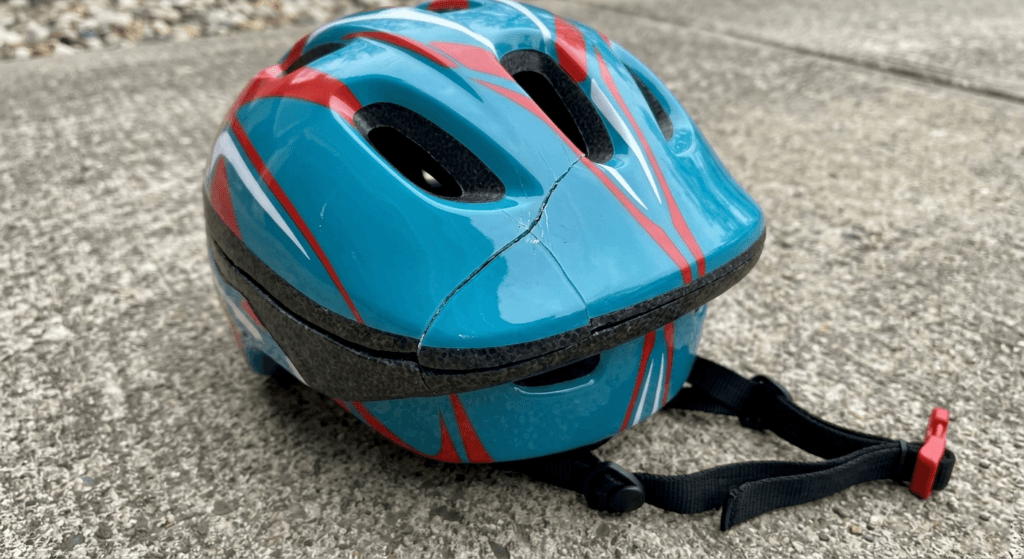
Kids are notoriously rough on their gear. Helmets are regularly dropped onto concrete driveways, scraped against school fences, or thrown into the bottom of toy boxes. While a scratch on the decorative plastic shell looks minor, the true impact-absorbing layer lies hidden underneath.
The Solution: Rule of Single Impact
Bicycle helmets are engineered as single-impact safety devices. The internal Expanded Polystyrene (EPS) foam core is designed to crush and fracture to absorb shock once. If a helmet sustains a hard fall onto a solid surface, that foam core may develop an internal hairline fracture. The helmet’s ability to protect your child in a future crash is gone. Inspect the outer shell and interior foam weekly; if you spot a deep cracked helmet shell or compression lines, replace it immediately.
3. Long Hair and Ponytail Interference
Thick braids, high ponytails, or hair clips completely alter how a helmet sits on a child’s head. When a helmet is forced to rest on top of a bunch of hair, it perches too high on the skull. This leaves the base of the skull entirely exposed to impact and makes the helmet highly unstable.
The Solution
- Tie a Low Ponytail: Always position hair ties at the absolute base of the neck, completely below the helmet’s rear retention cradle.
- Buy Purpose-Built Helmets: When shopping for new gear, search for modern models that explicitly state they are “ponytail compatible,” which include built-in cutouts in the rear plastic harness.
4. Degraded Internal EPS Protective Foam
Sweat oils, sunscreen, hair products, and ambient environmental heat all work together to slowly erode helmet materials. Leaving a bike helmet inside a hot car boot or a baking garden shed causes the interior EPS foam to dry out, grow brittle, and shrink away from the outer plastic shell.
The Solution
- Track the Expiry Date: Even if a helmet has never suffered a drop or crash, the industry consensus recommends replacing bicycle helmets every 3 to 5 years due to natural material breakdown.
- Proper Storage Habits: Wash internal comfort pads regularly with mild soap and water. Always store safety gear in a cool, climate-controlled, dry spot inside your home away from UV sunlight.